Our five senses are powerful anti-stress agents helping us adapt (Veiga-Fernandes and Mucida 2016).
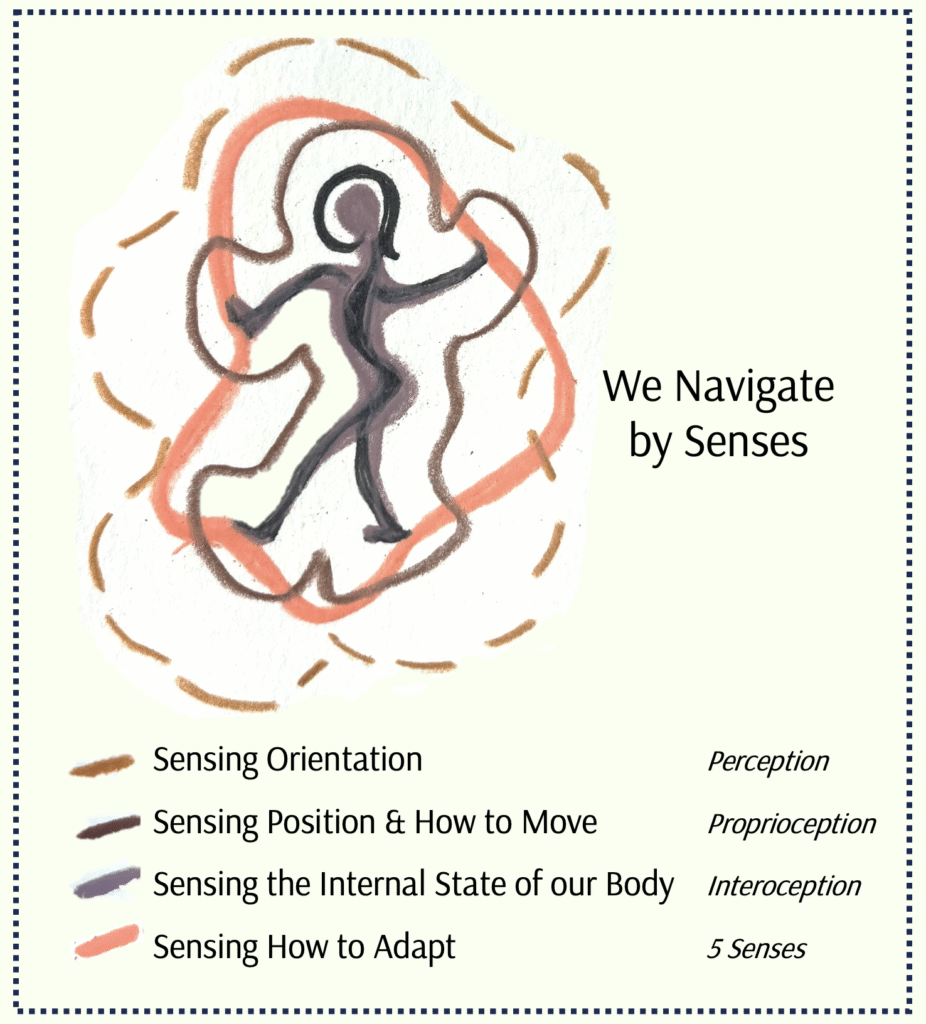
Our senses help us balance.
The higher the stress load we carry, the harder it is for our bodies to balance. It’s a colossal problem that 5 Senses Lab is working to solve.
Feeling stressed is a clue our body is trying to adapt. Our senses detect threat and send signals to our skin, gut, nerves and fluids which divert energy to defense — but when the threat isn’t solved by fighting or fleeing, stress can get stuck and immune responses can misfire to anxiety, eczema & high blood pressure — tilting us toward aging and disease.
Stress science and neuroscience show that we can increase positive emotion and decrease stress on a rapid and relatively effortless path by strategically activating each of the five senses (Rodriquez and Kross 2023).
Arousing our senses facilitates recall and enhances memory encoding (Critchley and Harrison 2009) because human cognition and how we feel in our bodies are highly controlled by the physical activity of our nerves and fluids (Critchley and Harrison 2013) and by signals from taste, touch, sound, smell and sight — guiding our decisions, memory, emotions and motivation (Tsakiris and Critchley 2016).
A big part of today’s stress epidemic is lack of relief. Balance requires relief from effort — like fully relaxing muscle fibers after a contraction is needed to build muscle optimally.
Relief, like stress, is also personal and tailormade. At 5 Senses Lab we are applying stress science to stress relief to put personalized relief in reach.
Stress antidotes must be tailormade.
The 5 Senses Mind/Body Review
At any moment in time, our bodies are shifting energy around trying to balance. The core of every 5 Senses experience is the Mind/Body Review, an of-the-moment reflection of how the body is optimizing energy right now and what sensory actions may offer relief.
The ten questions derive from a diagnostic technique for recovery and pain management adapted by Zeller et al (2024, a German gastroenterologist with Japanese physicians) from a classic Kampo Sho patient evaluation from traditional Japanese medicine. The answers indicate a pattern of excess/deficiency (temperature, moisture), strain and energy flow/stagnation. 5 Senses experiences relieve stress by providing proven sensory immersion exercises and tailormade suggestions for each user for restoring balance according to their pattern.
Sources
5 Senses Lab is sourcing sensory actions from peer-reviewed science: RCTs of stress mitigations and clinical findings of sensory pathways, causes and effects (olfactory/visual/auditory/taste/touch) and from classic texts of traditional knowledge about restoring balance (Japanese Kampo/Zen, Traditional Chinese Medicine/Qigong, and Ayurveda/Yoga). Exercises like color illumination are selected where science has verified their efficacy and from sophrology-known as mindfulness for people who can’t sit still.
Tech’s Stress Paradox
Tech today is caught in a stress paradox by turning our senses off and not on. Diminished senses are behind stress-associated lifestyle changes like eating behaviour while immobility diminishes our senses and can direct our bodies onto depression pathways (Critchley and Harrison 2009). To break out of its paradox, tech needs to reactivate the power of our senses.
Contact us at Relief@5SensesLab.com. Mahalo